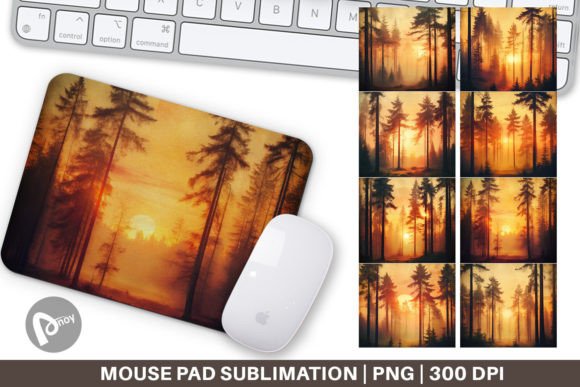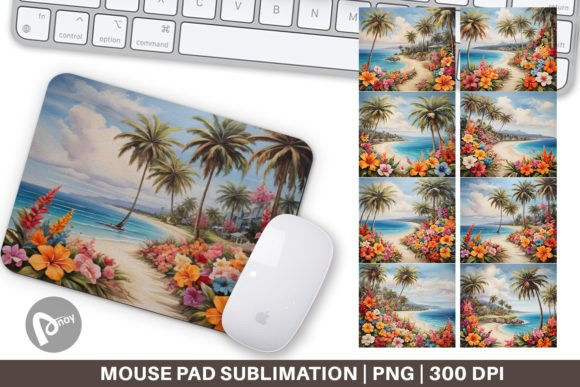
Mouse Pad Sunset Waves Beach: Aesthetic Desk Design as a Practical Workflow Investment
When you sit down to work, the surface beneath your hand is not just a passive object. A Mouse Pad Sunset Waves Beach design introduces a deliberate visual anchor into your workspace. The image of shoreline gradients and soft ocean tones does more than decorate. It establishes a sensory boundary between professional tasks and the mental noise that accumulates throughout a demanding day. Selecting a sublimation-printed mouse pad with this specific aesthetic is a micro-decision, but its compound effect across months of daily use makes it a genuine contributor to how you experience your desk routine.
Sublimation printing, the method used to transfer the Sunset Waves Beach artwork onto the pad surface, embeds dye directly into the material rather than layering ink on top. This technical distinction matters for anyone who logs extended hours at a computer. The surface resists peeling, fading, and the kind of edge wear that eventually makes cheaper pads look neglected. For professionals who treat their workspace as a reflection of operational standards, that durability parallels the expectation they place on other tools. A mouse pad that still looks intentional after a year of daily grinding reinforces a quiet sense of order.
Where a Curated Mouse Pad Fits Into Your Workspace Planning Process
Workspace setup is rarely a one-time event. You rearrange, upgrade peripherals, shift monitors, and gradually refine the environment that supports your output. A Mouse Pad Sunset Waves Beach enters this cycle as both a functional necessity and a visual coherence element. If you have already invested in a specific color palette for your desk—neutral tones, coastal accents, minimalist whites—the pad either integrates with that language or disrupts it. Choosing a design intentionally means you treat the pad the same way you treat monitor positioning or cable management: as a variable that either serves your concentration or quietly undermines it.
Creatives, in particular, understand how sensory details influence cognitive flow. A gradient that mimicks horizon light at dusk is not merely a pretty picture. It provides a soft focal point when your eyes leave the screen for brief resets. Those micro-breaks, often involuntary, can either land on clutter or on a composed visual. The Sunset Waves Beach motif offers the latter. Over a work session spanning several hours, the cumulative effect of those reset moments tilts toward calm rather than distraction.
How Aesthetic Desk Surfaces Interact With Productivity Rhythms
Productivity literature tends to overlook physical texture and imagery in favor of software hacks and time-blocking frameworks. But the tactile and visual environment is upstream from all of that. A sublimation mouse pad with a smooth cloth surface affects glide resistance, which in turn affects fine cursor movements during design work, photo editing, or spreadsheet navigation. Pairing that tactile consistency with a visually soothing design creates a dual benefit: precise control plus a low-level sensory signal that says the workspace is intentional, not accidental.
For professionals who toggle between deep-focus work and collaborative calls, the mouse pad sits in peripheral view during video meetings. While no one will scrutinize it directly, the absence of visual chaos on your desk registers. The Sunset Waves Beach design reads as clean and professional without being sterile. It suggests a personality without shouting for attention. That balance is hard to achieve with bolder, more saturated desk accessories.
Practical Considerations Before Integrating the Design Into Your Setup
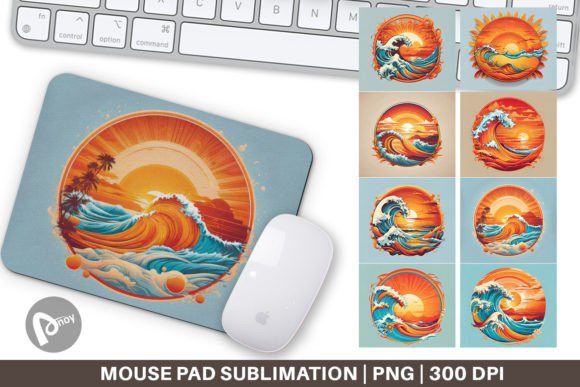
Before downloading the Mouse Pad Sunset Waves Beach digital files, assess your production pathway. The product delivers 8 PNG files sized at 9.5 x 8.1 inches, formatted at 300 dpi. Those specifications are deliberate. The dimensions accommodate standard rectangular mouse pad blanks commonly available from sublimation supply vendors. The 300 dpi resolution ensures that when the image is pressed, the wave gradients remain smooth rather than pixelating into visible bands. Understanding these inputs before you commit to printing saves you from misalignment between file capability and final product quality.
Check your press setup. Sublimation requires consistent heat, appropriate pressure, and a blank rated for polyester coating. If you work with a third-party printer, confirm they accept customer-supplied artwork and can preserve the original color profile. The sunset hues—warm oranges drifting into cool blues—can shift if the press operator uses a generic ICC profile instead of one calibrated for the specific substrate. A small pre-production sample or a single test press helps validate the output before committing to a full batch.
Compatibility Across Work Styles and Desk Configurations
Mouse Pad Sunset Waves Beach designs adapt to different workflows without demanding anything in return. A programmer who keeps a split keyboard and a trackball mouse gains the same surface consistency as a graphic designer running a high-DPI optical mouse. The pad's woven surface, once sublimated, supports both laser and optical tracking without the jitter that glossy or heavily textured pads sometimes introduce. That technical compatibility means you are not sacrificing functional reliability for the sake of appearance.The rectangular shape at approximately 9.5 by 8 inches provides enough real estate for medium-range cursor movements without dominating the desk. If your workflow involves dual monitors and side-to-side sweeps, ensure the pad size aligns with your typical motion arc. Some users pair a pad of this size with a separate keyboard wrist rest to create a modular ergonomic zone. The Sunset Waves design then becomes part of a larger physical system rather than an isolated purchase.
Using the Design as Part of a Broader Organizational Strategy
Desk organization often focuses on eliminating items. A more useful frame is intentional inclusion. Every object on your desk either earns its presence or erodes clarity. A sublimation mouse pad earns its presence twice: once as a precise tracking surface, and again as a visual container for your primary input zone. That container psychologically separates the interaction area from the rest of the desk. When you place your hand on the pad, your brain registers a transition into execution mode.
For educators, bloggers, and content creators who record tutorials or capture screen-plus-desk footage, the visual of the Sunset Waves Beach pad sitting beneath the mouse adds production value without requiring additional setup. It backgrounds a natural, unforced aesthetic. The coastal imagery suggests openness and clarity—associations that transfer subtly to the content itself. Consider testing camera angles to ensure the pad sits naturally in frame if you produce overhead desk shots regularly.
Long-Term Durability and Maintenance Patterns
Sublimation dye bonds at the molecular level to polyester fibers. That means the image will not crack, flake, or separate with regular cleaning. Over the lifespan of the pad, you can wipe the surface with a damp cloth and mild soap without degrading the artwork. For users in warmer climates or those who eat at their desks occasionally, this cleanability matters. The Sunset Waves Beach gradient also tends to mask minor dust accumulation better than solid dark or pure white pads, reducing the perceived need for constant upkeep.
Edged finishing is a variable you control at the production stage. Some sublimation blanks come with stitched borders; others are cut and heat-sealed. If you source your own blank, select one with reinforced edges to prevent the top layer from separating over months of wrist friction. The digital files you receive do not dictate the physical finishing, so treat the blank selection as a parallel quality decision. A well-chosen blank combined with a high-resolution print yields a pad that outlasts several hardware upgrade cycles.
Integrating the Mouse Pad Into Creative and Business Workflows
For small business owners who handle their own product photography, the pad serves double duty. Under a product shot, it provides a textured, non-distracting surface that adds context without pulling focus. The muted wave pattern creates depth behind small items like handmade jewelry, stationery, or tech accessories. This flexibility extends the value of the purchase beyond personal desk use into visual asset creation.
Freelancers who work across multiple locations can print multiple copies of the same design. Consistency across workspaces reduces the small cognitive friction of adjusting to a different surface each time you switch desks. The same Sunset Waves Beach visual waiting for you at the home office, the co-working space, or the client site desk creates a thread of continuity. It is a minor anchor in an otherwise variable work environment, and minor anchors compound into major stability over time.
How the Design Supports Decision-Making and Purchase Rationale
Choosing a sublimation mouse pad with a nature-inspired aesthetic rather than a generic solid color is a decision about how you want your workspace to feel during the unglamorous, repetitive stretches of work. The Sunset Waves Beach design does not demand engagement. It sits quietly, ready to catch a glance that might otherwise land on a notification or a stack of unfiled papers. That small redirection, multiplied by thousands of glances over a year, nudges your attentional habits toward restfulness rather than reactivity.
Publishers, marketers, and entrepreneurs who spend significant time reviewing documents, comparing layouts, or analyzing data benefit from maintaining a visual environment that regulates stress responses. Warm, low-contrast imagery has a documented calming effect, while high-contrast, chaotic patterns can subtly elevate cognitive load. The beach gradient operates in the former category. It is not a wellness intervention, but it is a sensible environmental choice for anyone who already optimizes their lighting, chair, and monitor placement.
Practical Implementation Steps for a Seamless Result
Start by verifying the file dimensions against your chosen blank. The 8 PNG files, each 9.5 x 8.1 inches at 300 dpi, provide flexibility if you want to test different color calibrations or produce a small batch. If you are new to sublimation, begin with a single press using one file. Evaluate the color transfer, sharpness, and edge alignment. Pay particular attention to the horizon line in the artwork. Any skew in the press will make the horizon appear tilted, which can become visually irritating over time even if the pad functions perfectly.
Once you confirm a successful press, integrate the pad into your desk layout with the same intention you apply to monitor height or keyboard angle. Position it so your forearm remains roughly parallel to the desk surface when your hand rests on the mouse. The pad should sit close enough to your keyboard that you do not need to overreach, but not so close that it crowds your typing zone. Small adjustments here prevent shoulder and wrist strain that accumulates silently over months.
Observations on Quality Control and Consistency
Because the files are digital downloads, the quality control shifts to your production stage. Inspect each PNG before printing for any compression artifacts along gradient transitions. The 300 dpi resolution should hold clean gradients, but confirm on a calibrated monitor that the blues do not posterize in shadow areas. If you detect banding, the issue is likely in the display rather than the file, but verifying prevents wasted blanks.
For those planning to resell finished pads or offer them as client gifts, consistency across a batch becomes a business consideration. Use the same blank model, press settings, and trimming method throughout. Document your settings so you can reproduce results months later without recalibration. A consistent product reflects attention to detail that clients and colleagues notice, even if they cannot articulate exactly what feels polished about the item.
Integrating the Mouse Pad Sunset Waves Beach Design Into a Long-Term Workspace Evolution
Your desk setup will evolve. Monitors will upgrade, peripherals will change, and your aesthetic preferences may shift over a multi-year span. A sublimation pad with a timeless coastal design resists obsolescence more effectively than trendy geometric patterns or brand-heavy gaming motifs. The Sunset Waves Beach artwork references a natural scene that does not date itself. It works alongside wood, metal, white, or dark desk surfaces equally well, giving you latitude to redesign your space without needing to replace the pad.
Consider also the seasonal rhythm. In winter months, the beach imagery provides a visual counterpoint to the gray outside a window. In summer, it harmonizes with the actual season. That year-round appropriateness keeps the pad integrated rather than stashed away for part of the year. The consistency of having one unchanging visual element on an otherwise fluid desk provides a subtle grounding effect that supports long-term workspace satisfaction.
Ultimately, the Mouse Pad Sunset Waves Beach is a single element in a larger system. But it is an element you interact with physically for thousands of hours. The sublimation print ensures it endures. The design ensures it pleases. The dimensions ensure it fits. When all three conditions hold, the pad transitions from a commodity to a deliberate component of how you work. And deliberate components, accumulated patiently across your entire workspace, define the difference between a desk you tolerate and a desk that actively supports the quality of your output.